SARS in Taiwan
The following information is our perspective on SARS in Taiwan, plus
some links that we have found useful in understanding the SARS outbreak.
We are not medical experts and make no guarantees as to the
accuracy of information below. If you are trying to decide whether to
stay in Taiwan or leave, or whether to come visit, I strongly
recommend that you do your own research regarding the situation here.
Probably the single best English-language source of information on
SARS is the WHO (World Health Organization) site:
WHO Severe Acute Respiratory Syndrome (SARS)
Throughout the WHO site, Taiwan is listed as "China, Taiwan Province".
Taiwan has not been permitted to join the World Health Organization.
Taiwan is not even permitted observer status. This is because the WHO
includes PR China, which regards Taiwan as a 'renegade province' and
has prevented Taiwan from joining the WHO. Sadly, political
considerations have carried more weight than humanitarian ones, even
in a body presumed to be dedicated to improving world health. Although
SARS was a problem in Taiwan as early as March, the WHO did not work
directly with Taiwan until the situation had already become serious.
Current information about Taiwan on the WHO site is accurate and
up-to-date.
Until recently, the U.S. CDC page was a more accurate source of
information regarding SARS in Taiwan than the WHO, since the U.S. CDC
had observers in Taiwan in April, while the WHO did not arrive until
May: http://www.cdc.gov/ncidod/sars/
The Taiwan government site has the "official line" on SARS:
The e-Government Entry Point of Taiwan
In general, the New York Times (requires
registration but is free) and BBC World News
have reasonably accurate news; however, on-line and print media often
contain errors or exaggerations. Local English-language Taiwan papers
include The Taipei Times and
The China Post. Other useful English news sites
include Taiwan Headlines.Com (see 'Latest Updates' bar to the
right of the page) and E-Taiwan News.Com.
We are asked daily whether we are afraid of SARS and whether we plan
to leave Taiwan early. As of this writing, there are over 150 SARS
cases in Taiwan, and I expect that the number may double or more
before the disease is under control. The population of Taiwan
is around 22-23 million. In other words, currently about
150/22,000,000 people, or about 1 in 147,000, are infected. Tripling the
number of cases, still only about 1 in 49,000 people would be
infected. Dengue Fever and Enterovirus-71 are more prevalent and
potentially more deadly in Taiwan, yet we still made an informed decision to
come. Consider that West Nile disease is more prevalent in the U.S.; in 2002
it affected about 1 in 69,000 people and has a mortality rate up to 15%.
(see http://www.cdc.gov/ncidod/dvbid/westnile/index.htm and
http://www.cnn.com/2003/HEALTH/05/09/sars/index.html)
As of this
writing, we are not particularly worried about SARS on an individual
level. That said, it does have the potential to become a major health
crisis, particularly in rural areas of mainland China.
It is unclear how prevalent local community transmission of SARS is in
Taiwan. Currently the WHO describes Taiwan's status as "High", meaning
that there are "Local probable cases occurring among persons who have
not been previously identified as known contacts of probable SARS
cases." See http://www.who.int/csr/sarsareas/en/ for the latest
figures. Taiwan officials dispute this claim, arguing that there are a
very limited number of such cases (fewer than half a dozen at this
writing). Only if local transmission increases dramatically, such that
the situation appears to be dangerously out of control, would we
consider leaving.
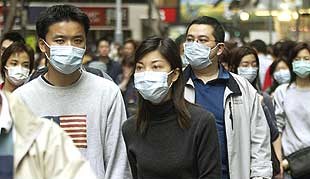
That said, life in Taipei is starting to get a little bit weird and
inconvenient... face masks, temperature checks, store closings, and the potential
for school closings.
For example, when we drop the kids off at school, they have their temperatures checked. When we
go to our respective buildings at Academia Sinica, we are checked and our temperatures are recorded in a log.
Even going to the department store yesterday, we were not allowed in the door without a temperature check. Since
there are many other minor illnesses that result in an elevated temperature, you can imagine that if you were
running a temperature for any other reason how you would be treated! For that matter, if you are coughing
in public, people give you a WIDE berth.
On mass transit (trains/subway), masks are required. Our subway stop is the last one on the Blue line;
a crew comes in and disinfects all surfaces that are liable to be touched by hands before the subway leaves
again. Many stores and schools scrub and disinfect every night after close of business. The goverment blares
out SARS announcements over the Civil Defense loudspeakers near our apartment, then people go to the
public market and wait in line for their allotment of disinfecting bleach.
The other interesting thing is that when people meet you or want to see the kids, they actually say things like
"Don't worry, I don't have SARS"!
- May 10th, 2003